I will sing for the one I love
a song about his vineyard:
My loved one had a vineyard
on a fertile hillside.
He dug it up and cleared it of stones
and planted it with the choicest vines.
He built a watchtower in it
and cut out a winepress as well.
Then he looked for a crop of good grapes,
but it yielded only bad fruit.
“Now you dwellers in Jerusalem and people of Judah,
judge between me and my vineyard.
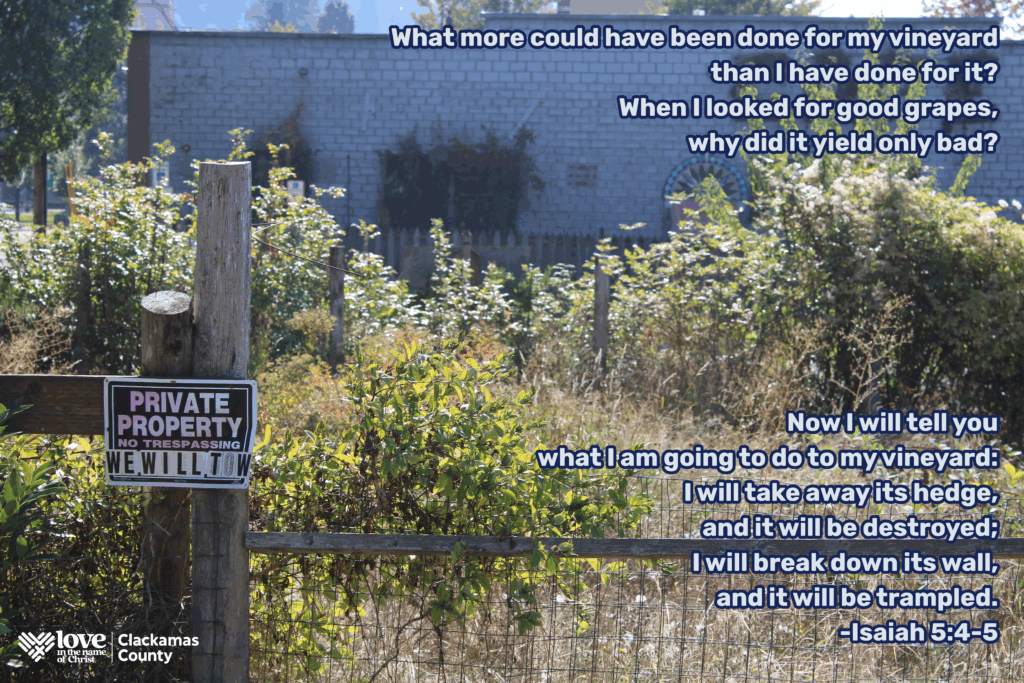
What more could have been done for my vineyard
than I have done for it?
When I looked for good grapes,
why did it yield only bad?
Now I will tell you
what I am going to do to my vineyard:
I will take away its hedge,
and it will be destroyed;
I will break down its wall,
and it will be trampled.
I will make it a wasteland,
neither pruned nor cultivated,
and briers and thorns will grow there.
I will command the clouds
not to rain on it.”
The vineyard of the Lord Almighty
is the nation of Israel,
and the people of Judah
are the vines he delighted in.
And he looked for justice, but saw bloodshed;
for righteousness, but heard cries of distress.
Isaiah 5:1-7
This parable shared by the prophet Isaiah reveals the extent of Israel’s depravity. That despite all that God gave them, all He did for them, they still turned away from Him. Despite all the law He gave them, outlining how He wanted them to live together in the land He gave them, they could not abide by His laws, they could not measure up to what He asked of them. Moreover, they did not grasp what He hoped for them to grasp from His law most of all, namely His love for them and all people. He looked to find justice among His people, but all He saw among them was violence.
While it is easy for us today to read our Bibles and recognize all the ways Israel failed in the Old Testament, it is more telling how easily we can point the finger and not see ourselves in their failure.
God gave His law to Israel to help them live flourishing lives. He created this metaphorical vineyard with all the support and protection they needed to thrive, and yet they cast it off to live their own way. One striking example is Israel’s desire to have their own king, like all the other nations (1 Samuel 8:5). Rather than be ruled by God, they wanted a man to rule them like all the surrounding nations had.
And what was the result of their discarding of God’s provision? God gave them what they wanted and the resulting consequences of their choices left their nation in ruins. And now we sit a read about this history and can clearly see their mistakes, but do we see our own mistakes as clearly?
How often do we compromise our Christian principles in the name of being effective?
How often do we rail against the selfish tendencies of our culture only to turn around and spend hours indulging in our own self-interest?
How often do we twist Scripture to justify our point of view on something or dismiss our questionable actions?
How often do we ignore the cries of distress around us, the need for justice in our community, because of our own self-interest?
What I hope we can all recognize is our shared humanity and failures with the people of Israel. I hope that Israel’s example will serve, not as something for us to sit back and judge (like how the Pharisee judged a tax collector in
Luke 18:9-14), but as something for us to see ourselves in and learn from. As Paul writes in
Romans 15:4, the Scriptures were written for us to learn from, both their mistakes and what they did well. But ultimately, the Scriptures were written to reveal God to us and help us to know Him, His heart and His character, more deeply so that we might live in the ways He designed for us to best thrive.
May we remain humble enough to relate to the failings of others so that in continued repentance, we can throw ourselves into the embrace of our Father’s arms and find healing in His Church. And through that healing, may we continually become ministers of reconciliation, bringing reconciliation to our world through our presence in places of pain.